Results tagged “cell phone laws” from Maryland Car Accident Lawyer Blog

Spying on Texting Drivers

October 17, 2012

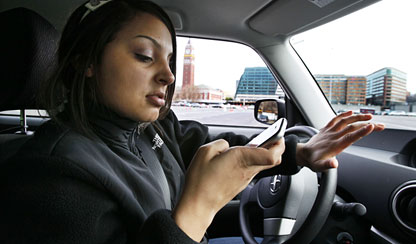
Text Distracted Driving.jpgThe Federal government wants to know whether you've been texting and driving. They have authorized grants to two states, Connecticut and Massachusetts, for anti-texting enforcement programs. Each state will get $275,000.00.
This money will be used to train police officers on how to detect texters--not only from their patrol cars, but from highway overpasses and more covert locations. I'm not sure how this will work, exactly. One police officer on a bridge, watching traffic come toward him. That officer radios to another officer on the road below, and tells him which car to pull over. Maybe it's as simple as that.

One thing is for sure--some people who flaunt Maryland's cell phone use laws are getting crafty--many keep the phones down below window-level to avoid police detection. Of course, that makes it harder to see the road, which is more likely to cause crashes.

Maryland automobile accident lawyers should have an arsenal of discovery ready to determine when illegal cell phone use may have contributed to an accident. In some cases, this involves written questions, requests for production of cell phone records, and subpoenas to cell phone companies.

See the U.S. Department of Transportation's press release and Ray LaHood's blog.

Increasing Penalties For Distracted Driving

July 11, 2012

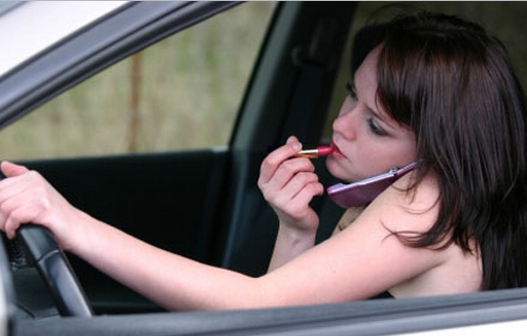
Given the prevalence of cell phones and smartphones, the likelihood is that many if not most automobile accidents are caused by distracted driving. The NHTSA estimates about 3,000 fatal distracted driving auto accidents in 2011. One study suggests that cell phones may be the cause of 1.6 million accidents per year, which is 28% of all auto accidents. Maryland has been improving the laws year after year, but some research questions whether existing laws around the nation are good enough.

distracted driving accident attorney.jpgAs far as punishment, some believe that higher fines will increase compliance, just as it did for seatbelt laws. New Jersey is considering a $200 fine for the first offense with a license suspension for 90 days for the third offense. Connecticut has already increased fines to $125 for a first offense. In Maryland, the fines are relatively light. Talking on a cell phone can cost $40 for a first offense and $100 for subsequent offenses. Sending or reading e-mails or texts is punishable by $70 fine for the first offense and $110 for subsequent offenses.

We should beef up the penalty provisions--larger fines and points (right now, there are no points issued for speaking on a phone for the first offense unless it causes a collision). Financial penalties provide most people with an incentive for good behavior, which will lead to safer roads.

What do Doctors, Drivers, and Pedestrians Have in Common?

May 14, 2012

Distracted pedestrian.jpgNone of them should be texting. We've blogged before about distracted driving and even distracted doctoring. Now, Fort Lee New Jersey is issuing tickets to pedestrians who ignore traffic signals or who jaywalk while looking down at their phones.

There were 117 tickets issued in one month, at $85.00 a pop. The question here, as with all governmental cell phone regulation, is whether the government should be taking this parental role? Opponents of regulation say that the government should just leave us alone, and that if we are stupid enough to text and walk across the street, we deserve to get run over. Proponents say that the problem does not just affect those who text--it affects the motorist who hits us, the person who hits them, and costs taxpayers money when someone isn't insured and needs medical care.

The problem is of course, widespread. A New York State Senator commented in an ABC news article on one of two deaths in Brooklyn:

A gentleman was standing on the corner ready to cross the street wired into his iPod, he crosses over and walks right into an NYC bus.

Here in Maryland, one of the problems is the law. Let's assume these facts:

  1. A pedestrian texting while crossing the street at a crosswalk--he has a walk signal
  2. A driver runs a red light, hitting the pedestrian
In that circumstance, the driver will undoubtedly argue that the pedestrian was contributorily negligent--that is, the pedestrian was partially responsible for his own injuries. The pedestrian would argue that, even if he was paying attention, he wouldn't have been able to get out of the way in time. However, the issue might be close enough to get to a jury (and you never know what a jury is going to do in a case like that). The pedestrian's case gets even worse if he is not crossing at a crosswalk.

Maryland's contributory negligence law is harsh--we're one of a very small number of states that still have this archaic rule. Basically, if the person filing the lawsuit was the negligent cause of his injuries, even by 0.01%, he cannot win a lawsuit. In other states, the plaintiff would be able to recover 99.99% of his damages. This makes sense, because the other guy had the most negligence.

distracted runner.jpgThese types of laws might bleed over into non-texting scenarios. What about runners? Almost every runner has an iPod or MP3 player plugged into their ears. If she doesn't hear a vehicle, and get hit even though the driver was speeding excessively, the runner might not be able to recover for her injuries.

Now, laws like this don't always provide evidence of what's called negligence per se. Negligence per se means that violation of the law is presumptive evidence that the lawbreaker was negligent. Whether or not that applies, the fact that the law becomes part of the public consciousness and the expectation of behavior means that an absolute defense of contributory negligence is more likely.

So, whether Maryland chooses to adopt these "distracted walking" laws, the safest course of action is to walk carefully, head up, and phone tucked away.

Contact Us
If you've been in a Maryland auto accident where cell phones, text messages, e-mails or other forms of distracted driving played a role, contact us at 443.850.4426, or online for a free consultation. You will speak directly to a lawyer from your first call. Don't let your case be handed off to a paralegal.